Rally demands voting protection in states like Arizona
Mar 1, 2013, 8:06 AM | Updated: 8:06 am
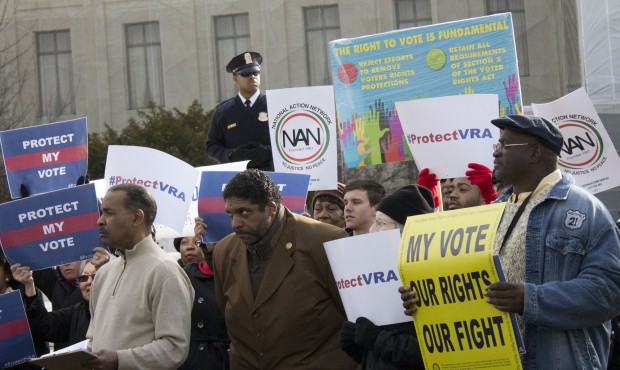

WASHINGTON — Hundreds gathered on the steps of the U.S. Supreme Court earlier this week to rally in support of a federal voter-protection law that governs mostly Southern states with a history of discrimination, including Arizona.
While the energetic crowd sang hymns and chanted, justices inside the court were hearing an Alabama county’s challenge to part of the 1965 Voting Rights Act that requires certain states to seek Department of Justice approval for every voting law change.
Bert Rein, the attorney representing Shelby County, Ala., said the law “does not protect the equal dignity of the states” and is unconstitutional for that reason. He also said that “the South had changed” since the law was passed, a claim that drew sharp questions from some justices and equally sharp responses from those rallying outside.
“The opponents of the Voting Rights Act say it’s antiquated and burdensome. That it’s past time. That we have evolved beyond that,” said Rep. Raul Grijalva, D-Tucson. “Well, we have not.”
Grijalva was joined by advocates, including Martin Luther King III, the Rev. Al Sharpton and the Rev. Jesse Jackson, and many who had come in on buses from Alabama and will continue to tour the South on the issue for the next several days.
Sharpton called the Shelby County case the latest in voting law changes around the country that are more-polished versions of Jim Crow laws, what he called “James Crow Jr., Esquire” laws.
Nina Perales, a vice president for Mexican American Legal Defense and Education Fund, pointed to recent voter ID laws in states like Texas and Arizona that she said had discriminated against minority voters, particularly Hispanics.
“Arizona has not changed,” Perales said, noting that the state’s congressional redistricting plans are routinely rejected by the Justice Department for potential discrimination. The Arizona redistricting plan proposed in the 2011 election cycle was the first not to be rejected, she said.
During the hearing, justices made the same argument about the continuing need for the law — Section 5 of the Voting Rights Act — in states such as Alabama.
Justice Sonia Sotomayor said that the Justice Department had rejected 240 voting laws in Alabama since 1982 under Section 5, and said Shelby might be the wrong county to bring the challenge.
“Why would we vote in favor of a county whose record is the epitome of what caused the passage of this law to start with?” she asked.
Justice Stephen Breyer noted that the abuses of the 1960s may no longer be in place in states like Alabama but that “the underlying evil is the discrimination,” and Congress recognized that evil when it renewed the law in 2006. He compared it to “an old disease, it’s gotten a lot better, a lot better, but it’s still there.”
“So if you had a remedy that really helped it work, but it wasn’t totally over, wouldn’t you keep that remedy?” Breyer asked.
But Rein argued that the formula in the law unfairly singled out certain states for federal oversight.
Several justices took that argument to Solicitor General Donald Verrilli, who defended the federal law. They asked him why only a few states should be subject to review, when they may have minority voter turnout that is higher than in some states that are not subject to oversight.
“Is it the government’s submission that the citizens in the South are more racist than citizens in the North?” Chief Justice Roberts asked.
A few justices suggested that oversight might be unnecessary because the law already prohibits discrimination. Justice Anthony Kennedy called Section 5 “reverse-engineering.”
Arizona is one of nine states where the entire state is subject to the law. Parts of seven other states are required to get federal voting-law review under Section 5.
Arizona was not represented at Wednesday’s hearing, but Arizona Attorney General Tom Horne had filed a brief in support of Alabama’s challenge. Horne said earlier this week that Section 5 is an administrative burden on his office and is no longer needed to protect voters from discrimination.
Perales disagreed. She said new attempts to disenfranchise voters are most persistent in states where the review is required, which is why the additional review under Section 5 needs to remain in those states.
Sharpton said he was not sure how the court would rule, but he vowed to take the fight to the streets again if the law is struck down. A ruling is expected this summer.
“We have not gotten so refined that we don’t march anymore,” he said.